Medical privacy curtains should be selected as part of a complete healthcare interior system, not as a standalone fabric product. The right combination of washable fabric, compatible curtain tracks, and durable wall protection helps maintain patient privacy, support daily cleaning, and protect high-traffic clinical spaces while keeping installation and maintenance requirements aligned.
For hospitals, outpatient clinics, nursing homes, and healthcare construction projects, choosing a medical curtain is not simply a matter of color or fabric weight. Buyers also need to consider fire performance, ventilation, installation details, cleaning procedures, and the condition of surrounding walls. These factors work together to determine how practical a privacy curtain system will be over time.
Medical privacy curtains are movable fabric partitions used to separate patient beds, examination areas, treatment spaces, and other shared areas in healthcare facilities. Unlike ordinary decorative curtains, hospital privacy curtains are selected according to functional requirements such as patient confidentiality, cleaning frequency, fire safety, and compatibility with medical curtain track systems.
In a hospital ward, a privacy curtain allows staff to provide examinations and routine care without exposing patients to unnecessary observation. In outpatient clinics, curtains can divide examination spaces without requiring permanent walls. Nursing homes and rehabilitation facilities also use them to balance privacy with flexible room layouts.
A complete medical privacy curtain installation normally includes three connected components:
These components serve different purposes, but they should be considered together during the design and purchasing process. A suitable curtain may still create operational problems if its track is difficult to operate or the surrounding wall surfaces are vulnerable to repeated damage.
Fabric selection affects privacy, durability, cleaning requirements, and fire safety. Polyester is widely used in medical curtain applications because it offers a practical balance of flexibility, dimensional stability, and ease of maintenance. However, the material name alone does not establish whether a fabric is suitable for a particular healthcare project.
Buyers should review the complete product specification, including fabric weight, construction, flame-retardant treatment, shrinkage, colorfastness, and cleaning instructions.
Fabric material and weight
Polyester medical curtain fabric is available in different constructions and weights. A heavier fabric may provide better visual coverage and a more substantial feel, but GSM should not be used as the only measure of privacy or quality. Fabric density, weave structure, color, lighting conditions, and the distance between the curtain and the patient all influence actual privacy performance.
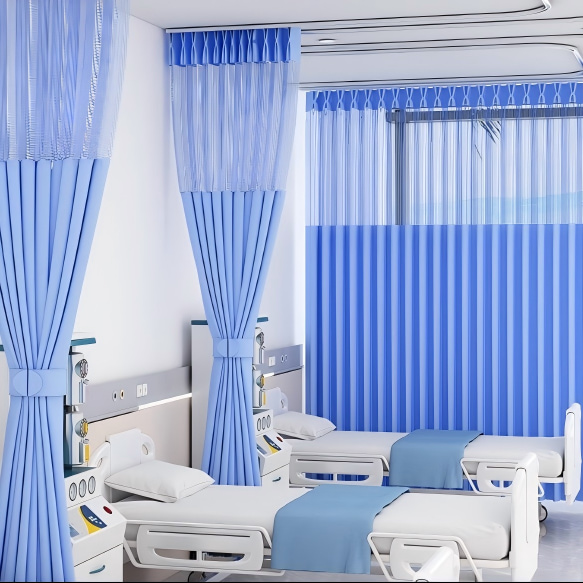
Pinger's published Hospital Privacy Curtains specifications identify 100% polyester fabric with a weight range of 200–250 GSM. The product page also lists a standard height of 2.8 meters and nine color options. Its elliptic-grid design includes a mesh ventilation section above the main curtain fabric.
These specifications provide a useful starting point for project discussions. Buyers should confirm the exact model, finished dimensions, available fabric construction, and current production specifications before placing an order.
Privacy and ventilation
A medical privacy curtain should provide sufficient visual coverage while allowing the healthcare facility to maintain its required ventilation arrangements. Some hospital curtains incorporate a mesh section at the top. This design allows air to pass through the upper portion while the main fabric provides patient privacy.
However, mesh size and curtain coverage should be reviewed alongside the room's HVAC and fire sprinkler design. A mesh top does not automatically guarantee adequate ventilation or sprinkler performance. The final arrangement must meet the requirements of the project and the applicable building and fire codes.
Cleaning, washing, and durability
Medical curtains are frequently handled by patients, visitors, and healthcare staff. Their surfaces may also be exposed to routine environmental contamination. For this reason, the fabric should have documented washing instructions and suitable resistance to shrinkage, fading, and repeated handling.
Before purchasing, request information about:
An antimicrobial treatment may provide an additional material-performance benefit, but it does not replace routine cleaning, hand hygiene, or infection-control procedures. Hospitals should follow their own environmental cleaning policies when determining how frequently curtains need to be inspected, washed, or replaced.
Flame-retardant performance
Fire performance is another important selection factor. Healthcare facilities should request test reports for the actual curtain fabric and confirm that the tested material corresponds to the product being supplied. A fire classification for a wall panel cannot be used as evidence that a textile curtain meets the same requirement.
For projects in the United States, Europe, and Asia, applicable fire requirements may differ. Buyers should specify the required test method and classification in the purchasing documents rather than relying on general descriptions such as fire-resistant or flame-retardant.
For product dimensions, fabric options, and available specifications, buyers can review Pinger Hospital Privacy Curtains and confirm the requirements for their intended healthcare application.
A medical curtain track determines how the privacy curtain is supported, positioned, and operated. The correct track should match the room layout, ceiling construction, curtain weight, and required coverage area. It should also allow staff to move the curtain smoothly without unnecessary effort.
Ceiling-mounted curtain tracks
Ceiling-mounted systems are commonly used for hospital cubicle partitions because they keep the curtain support above the patient area and allow flexible room arrangements. Before installation, the project team should confirm the ceiling structure, fixing method, track alignment, and access requirements for future maintenance.
Aluminum curtain tracks
Aluminum tracks are a practical option for healthcare curtain systems. They can be configured for different room layouts and are available in straight and curved arrangements. Their suitability depends on the profile, fixing method, carrier design, and load specifications of the selected system.
Track layout and operating requirements
A straight track may be suitable for a simple bed partition, while an L-shaped or U-shaped arrangement can provide more complete separation around a patient bed. The design should allow sufficient curtain movement without interfering with lighting, medical equipment, sprinkler heads, ventilation outlets, or other ceiling services.
The following comparison can help buyers understand the main differences:
| Track Type | Typical Application | Main Consideration |
|---|---|---|
| Straight ceiling track | Simple bed partitions and examination spaces | Track length and curtain coverage |
| Curved track | Partitions requiring changes in direction | Bend radius and smooth carrier movement |
| L-shaped track | Corner bed partitions | Corner clearance and mounting points |
| U-shaped track | Three-sided patient privacy areas | Opening access and full curtain coverage |
Important track components include mounting brackets, carriers or gliders, end stops, connectors, and suitable fixing hardware. These components should be compatible with the selected track profile and curtain configuration.
It is also important to consider maintenance. A track that is difficult to clean, inspect, or repair may increase operational inconvenience in a busy clinical environment.

Pinger's Medical Curtain Track range includes hospital cubicle curtain tracks, aluminum curtain tracks, and curved track options. Buyers can compare the available configurations according to their room layout and installation requirements.
Wall protection is an important part of healthcare interior planning, especially around patient beds, examination areas, nursing stations, and corridors. While medical privacy curtains provide visual separation, they do not protect the surrounding walls from repeated contact with beds, wheelchairs, medical carts, or cleaning equipment.
When curtain tracks and wall protection are planned together, project teams can address both patient privacy and the long-term condition of the surrounding interior surfaces.
Protecting walls around patient beds
Hospital beds are frequently repositioned for examinations, cleaning, transfers, and daily care. During these activities, bed frames and attached equipment may come into contact with nearby walls. Rigid wall protection sheets can help reduce scratches, surface damage, and maintenance requirements in these areas.
Protecting corners and high-traffic areas
Wall corners and corridor intersections are particularly exposed to impacts from mobile equipment and wheeled furniture. Corner guards and wall guards provide additional protection in locations where ordinary painted surfaces may deteriorate more quickly.
Supporting routine cleaning
Healthcare wall surfaces need to be compatible with the cleaning procedures used by the facility. The surface finish, joints, trims, adhesives, and sealants should all be considered because gaps and poorly finished edges can make cleaning more difficult.
It is important to distinguish between an easy-to-clean surface and a surface that has been tested for resistance to a particular disinfectant. Buyers should request chemical compatibility information for the actual product and cleaning agents used by the facility.
Coordinating curtain tracks with wall panel installation
When wall panels are installed near curtain tracks, the project team should coordinate the finished panel thickness, edge trims, mounting brackets, and fixing points. The track should be anchored to an appropriate structural support rather than relying on a decorative wall covering as its primary load-bearing support.
Planning these details before installation can reduce rework and help maintain a cleaner finish around the patient area.
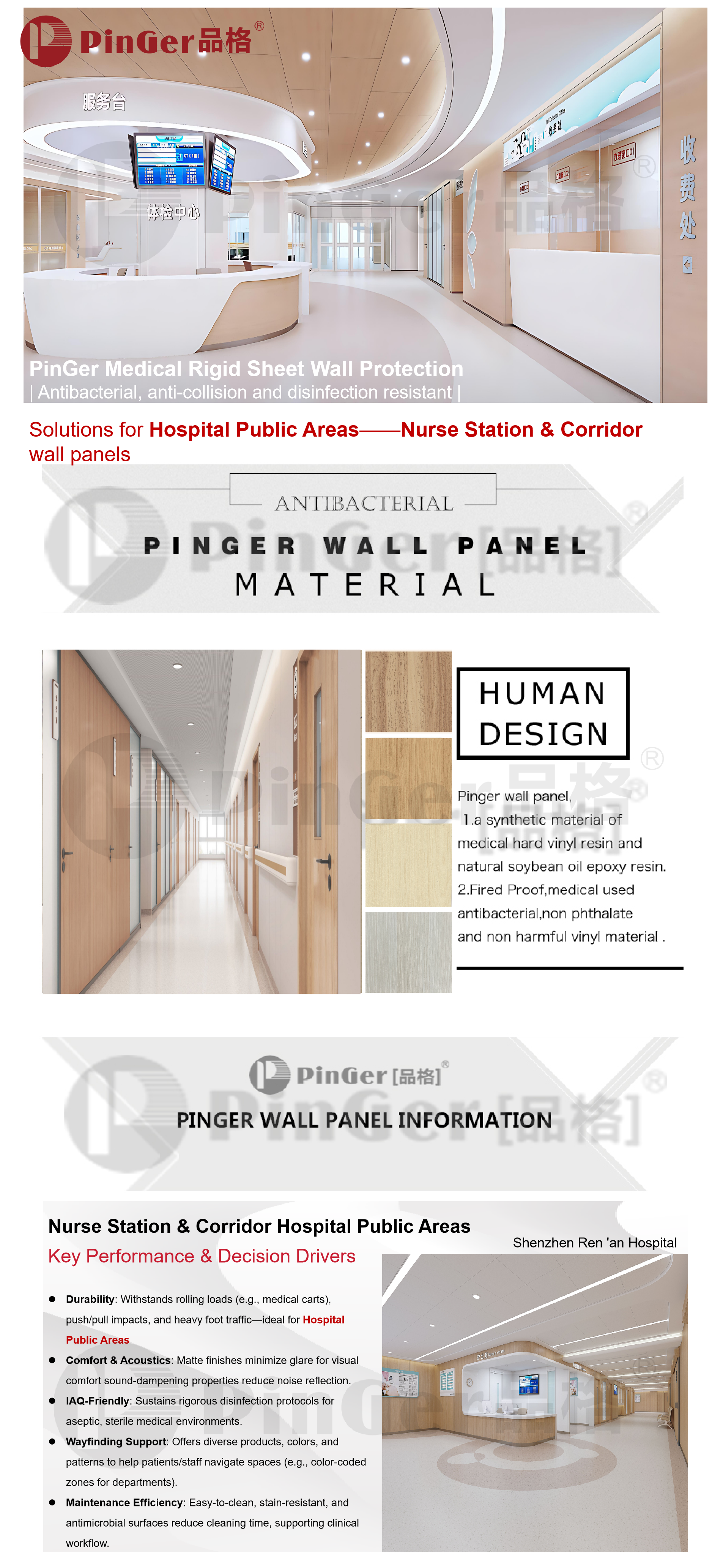
Pinger offers healthcare-oriented rigid vinyl wall protection products, including panels for clinical and nursing station environments. Its published product information lists thickness options from 0.8 mm to 3 mm, with standard sheet dimensions that vary by finish. The company also publishes technical information covering impact resistance, fire performance, and antibacterial and fungal resistance for its wall panel products.
For projects that require durable wall surfaces around beds and clinical work areas, see Pinger Rigid Sheet Wall Protection for Clinical and Nursing Stations.
International standards help buyers understand how a product has been tested, but different standards measure different properties. A fire test does not prove antibacterial performance, and an antibacterial test does not establish that a product is suitable for a cleanroom or resistant to every hospital disinfectant.
The following standards are relevant reference points for healthcare interior materials. Their applicability depends on the product type and the project specification.
| Standard | What It Tests or Classifies | What It Does Not Establish |
|---|---|---|
| ASTM E84 | Comparative surface flame spread and smoke development of building materials. | Does not measure heat transmission or prove a material is noncombustible by itself. It is not a general textile curtain test. |
| ASTM D256 | Izod pendulum impact resistance of specified plastics under defined test conditions. | Does not establish long-term wall durability, chemical resistance, or fire performance. |
| EN 13501-1 | Reaction-to-fire classification of construction products based on applicable test results. | Does not automatically classify every textile or establish the fire resistance of a complete building assembly. |
| GB 8624 | Classification of the burning behavior of building materials and products in China. | Does not replace product-specific testing or establish compliance with other countries' fire codes. |
| JIS Z 2801 | Antibacterial activity and efficacy on specified non-textile product surfaces, including plastics, metals, and ceramics. | Does not test textile curtains under its stated scope, prove infection prevention, or establish antiviral performance. |
| ASTM G21 | Resistance of synthetic polymeric materials to fungal growth under specified laboratory conditions. | Does not measure antibacterial activity or prove resistance to every mold species and real-world condition. |
| ISO 14644 | Cleanroom and associated controlled-environment requirements, including airborne particle cleanliness classification in Part 1. | Does not certify a curtain or wall panel as antibacterial, sterile, or infection-proof. |
| CDPH Standard Method 01350 | VOC emissions from indoor building products using chamber-based testing and exposure modeling. | Does not establish fire safety, antibacterial performance, or the absence of every potentially harmful substance. |
Accessibility dimensions also need careful interpretation.
For projects in the United States, the ADA Standards include specific requirements for accessible routes, doors, handrails, and grab bars. The 34–38 inch range applies to the height of handrails under the relevant ADA provisions; grab bars have a different specified height range, generally 33–36 inches. The 250 lbf structural strength criterion applies to grab bars and their supporting structures under the applicable requirements. These figures should not be treated as universal curtain track installation dimensions.
EN ISO 21542 addresses accessibility and usability of the built environment. A 900 mm clear width may be a relevant design reference in certain contexts, but the required width must be checked against the applicable national adoption, building type, circulation condition, and project requirements.
For healthcare buyers, the most important point is to request the actual test report, identify the tested material and thickness, and check whether the result applies to the finished product being purchased.
Coordinating the three components early helps avoid mismatched dimensions, difficult installation details, and unnecessary maintenance. A curtain supplier, wall protection supplier, architect, and contractor should work from the same room layout and technical specification.
For example, a standard patient room may require a polyester privacy curtain, a ceiling-mounted track around the bed, and rigid wall panels in areas exposed to bed and equipment movement. The exact configuration will depend on the room dimensions, patient care procedures, ceiling structure, and local regulations.
Use the following checklist when preparing a medical privacy curtain specification:
This process is useful for both new healthcare construction and renovation projects. It also makes it easier to compare quotations from different suppliers because the purchasing team is evaluating products against the same requirements.
Medical privacy curtains are used in several types of healthcare environments. The most appropriate fabric, track layout, and wall protection arrangement will vary according to how each space is used.
Hospital patient rooms
Patient rooms typically require reliable visual separation, convenient curtain operation, and easy access for staff. Wall protection around beds and frequently moved equipment can help reduce surface damage.
ICU and emergency departments
These areas require careful planning around equipment access, emergency movement, cleaning procedures, and the positioning of ceiling services. Curtain systems should not obstruct essential medical equipment or emergency access routes.
Examination and treatment rooms
Examination rooms often benefit from flexible partitions that can be opened or closed quickly. The curtain fabric should provide suitable privacy while allowing the room to be cleaned according to facility procedures.
Nursing homes and rehabilitation facilities
These facilities may require a combination of patient privacy, comfortable interior design, and durable wall surfaces. Handrails, corner guards, and wall protection can be considered alongside curtain systems, particularly in areas used by residents with limited mobility.
Healthcare projects in Vietnam and other Southeast Asian markets
For hospitals and clinics in urban areas such as Tân Phú, Ho Chi Minh City, buyers should consider local installation conditions, room ventilation, humidity, cleaning practices, and applicable fire regulations. Fabric selection should account for the facility's actual maintenance capabilities rather than relying on a general product description.
Suppliers should also provide clear technical specifications and installation information so that local contractors can coordinate the curtain system with wall finishes and ceiling services.
Pinger provides products for healthcare interiors, including medical privacy curtains, curtain tracks, and wall protection systems. Its product range allows project buyers to evaluate different elements of a healthcare interior through one supplier rather than treating every component as an unrelated purchase.
The published Hospital Privacy Curtains range includes polyester fabric options, mesh ventilation structures, and multiple color choices. Its Medical Curtain System category also includes ceiling-mounted and aluminum curtain track options for different layouts.
For wall protection, Pinger offers rigid vinyl wall sheets and related products designed for clinical areas, nursing stations, corridors, and other high-traffic interiors. Published wall panel specifications include multiple thickness options, standard sheet dimensions, impact-related testing information, and antibacterial and fungal resistance test references.
These product categories address different requirements within the same healthcare environment:
For hospitals, contractors, distributors, and healthcare interior designers, the practical next step is to compare product specifications against the actual project drawings and maintenance requirements. Pinger can be considered for projects that require medical curtain systems and complementary wall protection products.
To discuss product configurations, dimensions, material options, or project requirements, contact the Pinger team through the official website.
What fabric is best for medical privacy curtains?
Polyester is a commonly used option because it offers flexibility, durability, and practical maintenance characteristics. The best choice depends on the required privacy level, fabric weight, fire performance, washing instructions, and the healthcare facility's cleaning procedures.
How often should hospital privacy curtains be changed?
There is no single replacement interval that applies to every hospital. Curtains should be inspected and cleaned or replaced according to the facility's infection-control policy, contamination risk, visible condition, and manufacturer cleaning instructions.
Are medical privacy curtains required to be fire resistant?
Fire performance requirements depend on local building codes, healthcare facility regulations, and project specifications. Buyers should request applicable fire test reports for the actual curtain fabric instead of assuming that a general flame-retardant description proves compliance.
What is the difference between a hospital curtain track and a regular curtain rod?
A hospital curtain track is designed for movable cubicle partitions and can use ceiling-mounted profiles, carriers, connectors, and curved sections. A regular decorative curtain rod is not necessarily designed for the movement patterns, installation conditions, or maintenance needs of healthcare spaces.
Why is wall protection important around hospital privacy curtains?
Privacy curtains do not protect nearby walls from bed frames, wheelchairs, carts, and other equipment. Wall panels, wall guards, and corner guards help reduce impact damage and make high-traffic healthcare areas easier to maintain.
Author: Pinger Technical Team
Technical information and data sources: Product specifications published on the official Pinger website, including Hospital Privacy Curtains and Rigid Sheet Wall Protection for Clinical and Nursing Stations.
Project data note: The dimensions, material options, and performance information in this article are based on published product specifications and standard descriptions. No unpublished customer project measurements or independent laboratory results are represented as verified data. Buyers should request current model-specific test reports and technical documentation before specification or procurement.


 IPv6 network supported
 English
 français
 Deutsch
 русский
 italiano
 español
 português
 العربية
 한국의
 Tiếng việt
 Indonesia
 中文